Work · 2026
Enterprise AI
an agent in your stack
2026 · automation / analytics
What you see
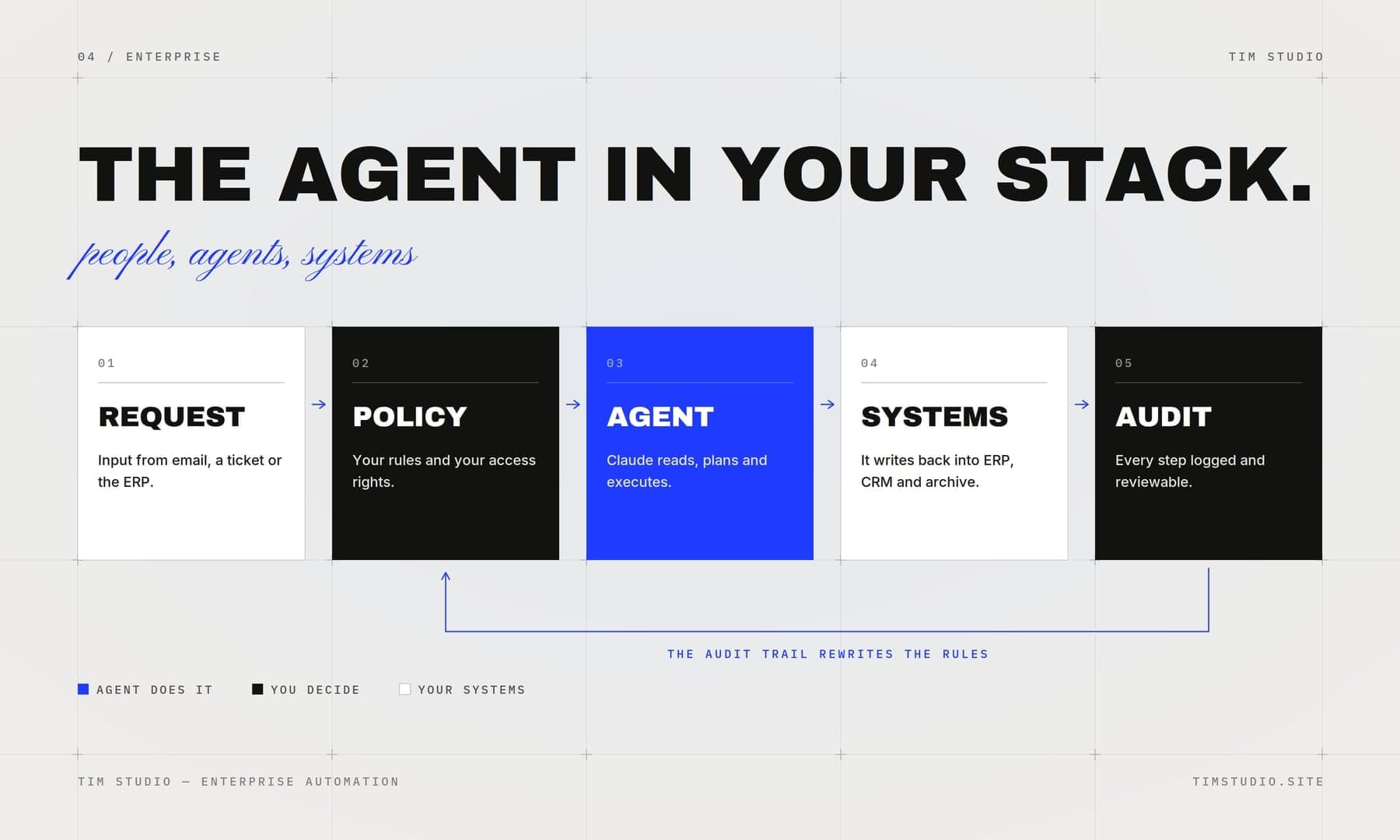
A diagram, not a screenshot: an agent in your stack in five steps, request (input from email, a ticket or the ERP), rules (your policies and access rights), agent (Claude reads, plans and executes), systems (writes back to the ERP, the CRM and the archive), audit (every step logged and verifiable). The legend says what the agent does, what you decide and what your systems are.
This is an example architecture of how the studio automates processes, analytics and outreach for larger companies, not a named client's project. That work sits under NDA, so here we show what the system looks like once assembled, not whose data runs through it.
The brief
A larger company already has its systems: an ERP for goods and finance, a CRM for sales, an inbox full of inquiries and folders of documents. The problem is not a lack of tools but the manual work between them: data retyped from one into another, a report someone assembles every Monday, an inquiry waiting for someone to read it. The brief of such a project is to connect those tools and let everything that follows a pattern run on its own.
What we built
An orchestration layer on n8n between the existing systems and the people. The company's systems come in as sources: ERP, CRM, inbox, documents. In the middle sit AI agents with clearly bounded jobs: read an inquiry and sort it, pull data out of a document, draft a reply or a proposal, assemble a report. On the way out are analytics dashboards that refresh themselves, reports that arrive on time, outreach that runs by rules and processes that no longer wait for a hand. Every flow has monitoring, so a failure is seen before it reaches a client.
What it did
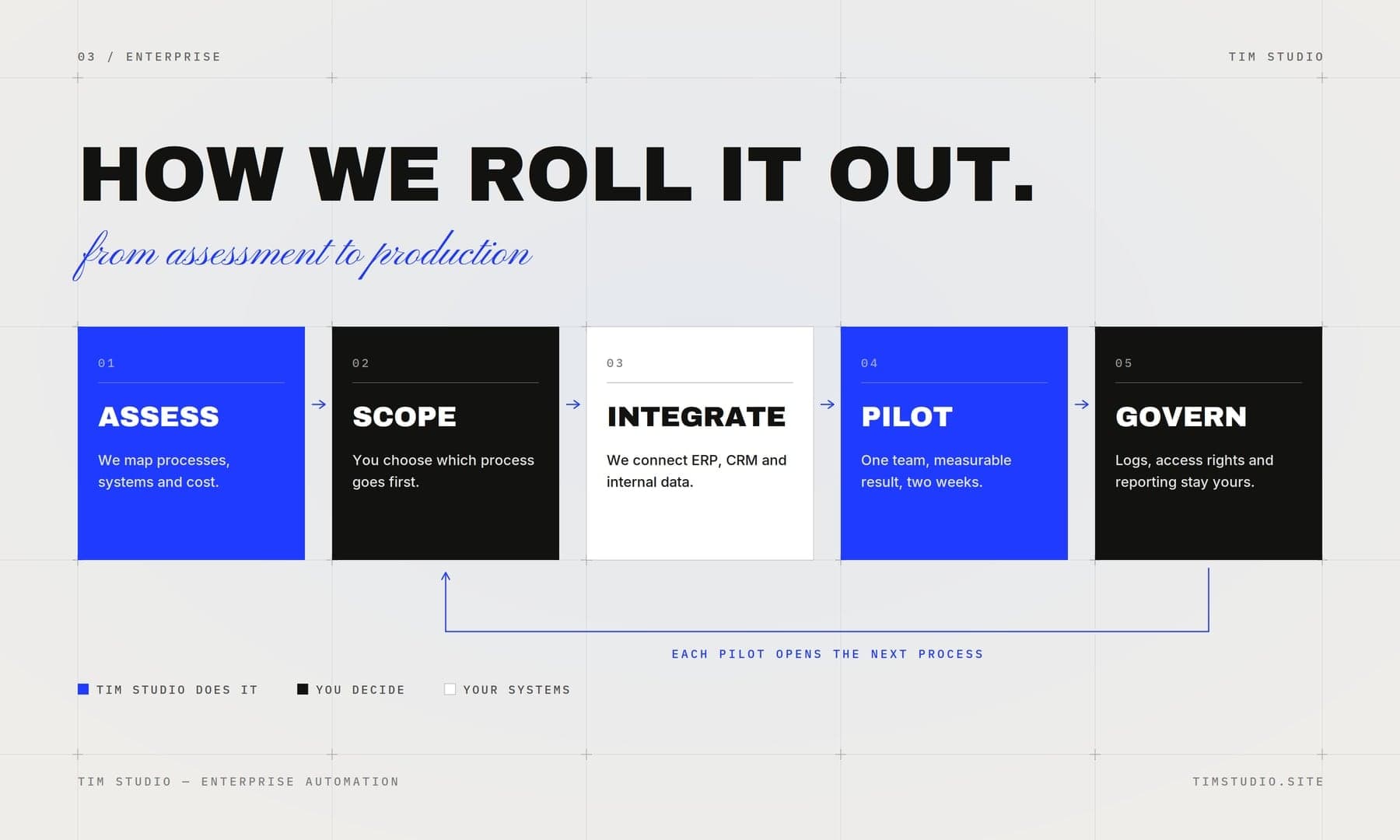
Since this is an example architecture, we publish no figures; we publish the approach. Every flow is mapped on paper first, then only what makes sense is automated, and people stay where a decision needs a person. If your company has an ERP, a CRM and an inbox that do not talk to each other, this is the picture of what it looks like when they do.
Write to us.